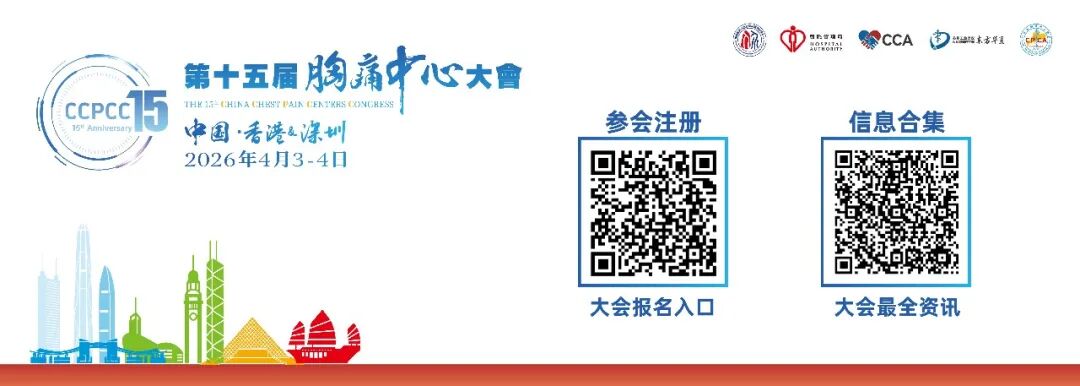
The 15th China Chest Pain Centers Congress (CCPCC2026) will be jointly held in Hong Kong and Shenzhen on April 3–4, 2026, bringing together experts and scholars in the field of chest pain care. A dedicated Emergency Medicine and Pre-hospital Care Forum will explore topics including the integration of emergency care systems, informatization development, and high-quality advancement of emergency care capabilities. The forum aims to foster synergy across regions, information, and clinical processes, promote the vision "A call triggers rescue; boarding an ambulance equals hospital admission", and provide practical insights for optimizing treatment workflows and reducing out-of-hospital mortality rates.
Forum Name: Emergency Medicine and Pre-hospital Care Forum
Venue: Hong Kong Convention and Exhibition Centre (S223)
【Forum Schedule】
April 3 (Friday)
11:00-12:00 | Session 1: Integration and Innovation in Emergency Care Systems Toward International Advancement of Chest Pain Centre
14:10-15:30 | Session 2: Chest Pain Centre System Development and Digitalisation
15:30-17:30 | Session 3: Enhancing Emergency Capabilities and High-Quality Development in Chest Pain Care
【Q&A | Your Top 3 Most Concerned Questions Answered!】
Q1: The operational logic of emergency care systems differs between Hong Kong and Chinese mainland. What practical value does understanding an alternative model have for clinicians in their daily practice? Can the forum provide replicable experiences?
A1: It is extremely valuable! Session 1 features a dedicated "Integration and Innovation" segment. It will conduct an in-depth analysis of the successful experience of the chest pain center model in building regional collaborative care systems in Chinese mainland, and share Hong Kong’s practical insights on achieving seamless connection between pre-hospital emergency care and in-hospital green channels. The two models have their own distinctive features, yet share the same core goal: to shorten treatment time and improve survival rates. Through this exchange, participants can broaden their perspectives and observe how efficient coordination can be achieved within different healthcare systems.
Q2: Our hospital occasionally experiences information disconnects and poor coordination between pre-hospital emergency care and in-hospital emergency departments. What specific solutions can the forum offer to address these issues?
A2: The issues you raised are exactly the core focus of Session 2. Informatization development is the key to bridging information silos. The forum will share a number of proven practical experiences: including a smart pre-hospital chest pain care model that demonstrates how to realize real-time patient data transmission and early alert activation through informatization tools; data-driven approaches for early and accurate assessment that enable more scientific clinical decision-making; and experience sharing from remote areas in western China, which proves that optimized processes and informatization can effectively improve treatment efficiency even with relatively limited resources. In addition, speakers will break down the key links and process optimization strategies for pre-hospital emergency care in detail, helping you identify actionable improvement points for your hospital to achieve smoother coordination and real-time information synchronization.
Q3: In daily practice, we often treat chest pain patients with complex conditions, such as those complicated by cardiogenic shock or gastrointestinal bleeding, which brings great clinical pressure. How can emergency physicians enhance their ability to manage such complex scenarios? What practical takeaways will the forum offer?
A3: We understand the challenges faced by frontline clinicians. Managing complex cases indeed requires continuous professional capacity building. Session 3 is a tailor-made capability enhancement session for you. A number of highly experienced experts will conduct in-depth analyses of the most challenging clinical scenarios: How to early identify acute myocardial infarction complicated by cardiogenic shock and implement appropriate management? How to conduct assessment and decision-making for myocardial infarction complicated by gastrointestinal bleeding? How to formulate PCI strategies for patients with out-of-hospital cardiac arrest? What are the methods for urgent diagnosis of life-threatening chest pain? What are the indications and protocols for ECMO application in refractory cardiac arrest and cardiogenic shock? Each topic directly addresses clinical pain points and is combined with real-world cases, helping you feel more confident when managing critically ill patients and further enhancing your ability in precise clinical judgment and comprehensive management.
From system integration to information connectivity, and from capability building to complex case management, every discussion and every case lays a solid foundation for racing against time in life-saving care. If you also aspire to secure more chances of survival for your patients and build greater confidence for your team, join us on April 3 at the Emergency Medicine and Pre-hospital Care Forum of the 15th China Chest Pain Centers Congress. We look forward to seeing you there!